DAOs Are Dead. Public Goods Funding Is Dead. Neither Is True.
“DAOs are dead!” (People)
“Public Goods funding is dead!” (People)
“Neither of these are true!” (Me)
The previous versions of them died, changed, or were abandoned, and both for largely the same reason.
They failed to build on the most fundamental layer of all.
Trust.
Or maybe more accurately, people assumed the trust was already there. Proving again the old saying: when you assume, you make an ass out of you and me.
We built proxies for it.
We built incentives around it.
We built cryptographic mechanisms intended to reduce how much of it was necessary.
But we never really built trust itself into the infrastructure.
And in the case of DAOs I think we need to go back even further, because I am not convinced we ever actually tried them.
We tried token voting.
We tried delegation.
We tried skin in the game.
We tried multisigs and councils and Snapshot and forums and working groups and onchain voting and forks and rage quits and all kinds of combinations of these things.
Those are mechanisms.
Some of them are very useful mechanisms.
But they are not a DAO.
Token ownership tells me you own a token. Delegation tells me someone gave you their voting power. Skin in the game tells me you have something to lose. Participation tells me you showed up.
None of those tell me whether you make good decisions, whether you did the work, whether the work was good, or whether the previous ten decisions you made created value or destroyed it.
They don’t tell me whether you should be trusted with more authority tomorrow than you had yesterday.
Trust proxies are not trust infrastructure.
Some DAOs started massively centralized with the stated intention to decentralize later.
But people are people.
Giving up power is hard. Sometimes the community doesn’t even want the founders to give it up because the founders and core contributors are the only people actually doing enough work to keep the organization alive.
Others made governance itself liquid and purchasable and then we somehow acted surprised when financial incentives and governance incentives eventually separated.
Putting token price and governance in the same bucket is like oil and water.
Shake it however you want. Eventually it separates.
This doesn’t mean decentralized governance is impossible.
It means thinking a token was going to solve the distribution of power makes very little sense.
Governance is hard.
Who should have authority? How much? For how long? How do they earn more of it? How do they lose it? When is the person disagreeing with everyone else an idiot and when are they the only person in the room who sees the problem?
Nouns DAO got closer
Nouns DAO remains one of the more interesting experiments because it didn’t begin exactly like most token DAOs.
It didn’t mint the governance supply, sell the thing, fill a treasury and then ask a Discord server to figure out what the organization was for.
Nouns are created one at a time through an ongoing auction.
One Noun, one vote.
Capital enters the treasury as new members enter the organization.
There is something much more organic about that.
And Nouns still does amazing work.
Art, software, films, events, public goods and wonderfully strange things that probably would never make it through a normal institutional funding process. It created one of the more interesting CC0 cultural experiments in crypto and has kept it alive for years.
And even Nouns ran directly into the hard parts.
The economics of exit became part of governance. The fork mechanism came. Arbitrage had to be considered. Eventually the Break Even movement arrived with the very reasonable argument that Nouns needed more financial discipline and a better understanding of how much value was being created by what it was funding.
None of that means Nouns failed.
Nouns learned.
Probably better than most because it is still alive and still learning.
The lessons are expensive. The price to learn with Nouns is now expensive too.
What interests me more than whether Nouns spent too much on one proposal or too little on another is why governance power itself does not become informed by those learnings.
If someone repeatedly makes wise decisions, shouldn’t that matter?
If someone has done useful work for five years, shouldn’t that matter?
If someone repeatedly spots risks before everyone else sees them, shouldn’t the system remember?
Not forever. Not absolutely. Not in every domain.
But it should matter.
That brings us directly back to a problem public goods funding has been wrestling with for years.
MRV.
Measurement, reporting and verification.
Just in another form.
ENS DAO is another version of the same problem
ENS is a useful current example.
ENS tokenholders approved a restructuring that moves much more day-to-day operating responsibility into the ENS Foundation.
And I understand why.
Token voting is a terrible way to run an operating company.
People don’t want to vote on everything. Most don’t have the information or time required to vote intelligently on everything. Participation falls and eventually the people who know the organization best are still making most of the decisions.
Then you are back to centralization, except now there is a token voting layer sitting around it.
The ENS Foundation and ENS Labs are legally separate, and the new Foundation structure includes independent directors, so saying Labs simply “took over” the DAO would be too easy.
But the overlap is real.
The Executive Director came directly from ENS Labs. Nick Johnson remains founder and CEO of ENS Labs while holding the founder seat at the Foundation. Some delegates called the restructuring capture. Others thought it was exactly the operating structure ENS needed.
The proposal passed.
I don’t think the interesting question is which side was right.
The interesting thing is that we are back to the same questions about power, merit, accountability and authority.
A token can prove ownership, voting weight and financial exposure.
Those are useful facts.
But we kept asking them to answer a different question:
Who should govern?
Public Goods funding came at the same problem from the other direction
Public Goods funding platforms ran into another version of this.
A lot of them wanted SaaS-style growth out of a very complicated problem. They wanted PMF for objectives that don’t necessarily follow a PMF curve.
They looked at governments, foundations and NGOs and the massive amount of capital distributed badly, slowly, politically, opaquely or without much understanding of what happened afterward and thought cryptographic coordination could make it better.
I still think it can.
Absolutely.
But sending the money was never the hardest part.
Crypto is very good at sending money.
The hard part is everything around it.
Who deserves the money? What did they say they would do? Did they do it? Who verified that? Was what we measured even important? Would I fund them again?
MRV became important because it always was.
The problem is that much of it arrived after the funding mechanism was already standing, so everybody invented their own metrics, reports, forms, impact language and definition of good evidence.
Then we wondered why participation was difficult.
And this becomes much harder outside software.
Software is comparatively easy to verify. There is code. There is a repository. Something works or it doesn’t.
Now try doing it with a farm, a watershed, education, culture or a community.
Regenerative agriculture creates value across soil, water retention, biodiversity, resilience and human knowledge over time.
Now MRV is hard.
If we want that evidence onchain it gets harder again.
The data needs to be credible, comparable, flexible, simple enough to upload and cheap enough to verify.
It also needs to remain useful outside the particular funding platform that requested it.
A farmer should not need to become a data scientist and blockchain engineer because somebody gave them a grant.
A researcher shouldn’t need to learn a new reporting language every time they change funders.
No one should have to build reputation from zero because the grants platform they used last year no longer exists.
That is the infrastructure problem.
These weren’t failures. They were very expensive learnings.
This is important because I don’t think most of these systems failed in the way people like to say they failed.
They learned.
Gitcoin learned an enormous amount about quadratic funding, sybil resistance, community rounds, matching pools, identity and impact.
Grants Stack is still one of my favorite examples because it was just becoming useful when it was killed.
It was complicated.
Of course it was complicated.
The problem it was trying to solve is complicated.
Millions were spent developing it, and just as that complexity had the chance to become standardized, simplified and boring enough for other people to really build on, the cost of maintaining it became the reason to shut it down.
The bathwater the baby was thrown out with was all of the money, time and institutional knowledge already spent learning how to build it.
That doesn’t mean Grants Stack should have operated forever regardless of cost.
It means abandoning infrastructure has a cost too.
Crypto is terrible at pricing that.
We price token value and TVL.
We price growth and volume.
We don’t price accumulated learning particularly well.
Gitcoin continued and changed. Good.
The question is whether the learning survives the product.
Giveth has learned another part of the problem. If you fund thousands of projects, eventually somebody needs to know whether they are real and whether they do what they say. So Giveth has verification, human verifiers, attestations and DeVouch.
Endaoment approaches the problem from another direction, using onchain rails for philanthropy while still having to determine which organizations are actually eligible to receive money.
Octant puts capital to productive use and directs some of the value produced toward public goods. It is sustainable, but it is still evolving.
RetroPGF asked whether we could stop pretending to know everything worth funding beforehand and instead reward value after some of it became visible.
Artizen is trying another model again: different funds, different communities, different types of builders, matching and different sources of capital.
I find Artizen particularly interesting because I don’t think one public goods funding mechanism is ever going to “win.”
Software infrastructure is not a forest.
A film is not scientific research.
A public park is not open-source cryptography.
Why would one allocation mechanism understand all of them equally well?
What should be shared is not necessarily the funding mechanism.
It is the learning underneath it.
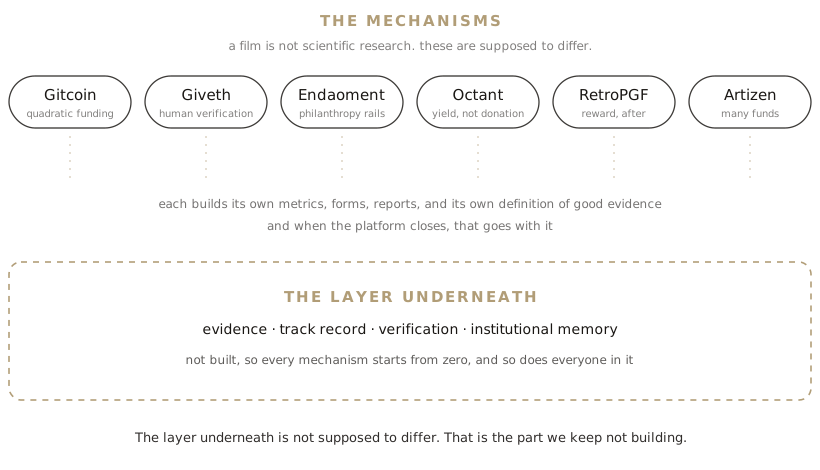
Can Artizen inherit something Gitcoin learned?
Can Giveth verification mean something outside Giveth?
Can someone who successfully delivered through one system carry that history into another?
Can MRV survive the grants platform?
That is where I think we keep leaving value (trust) on the table.
MRV and governance are closer than they look
This is where the DAO and Public Goods funding arguments come back together.
Someone received money. What did they produce?
Someone received authority. What did they do with it?
Someone promised work. Was it done?
Someone made repeated decisions. Did they create value or destroy it?
That is an MRV problem, even if we don’t usually call it that in governance.
What we need is not a universal reputation score or a number declaring someone a “good actor.”
Merit has context.
The evidence should accumulate without becoming permanent judgment: work, decisions, outcomes, mistakes and verification.
Someone who repeatedly makes wise decisions in a particular domain should probably have more authority there than someone who bought a governance token yesterday.
Someone who repeatedly delivers should not start from zero every time they need funding.
Simple philosophically.
Horribly complicated operationally.
Which is probably one reason we kept reaching for tokens.
AI may finally make some of this complexity manageable
If the answer to all of this is another fifty fields on a grant application, I don’t want it.
If putting MRV onchain means producing even more bureaucratic garbage, we have learned nothing.
This is where AI x Crypto and DAOs become parts of the same armor.
Not because AI should decide who deserves to be trusted.
It shouldn’t.
But AI can help strip away some complexity around the human.
An agent can take messy evidence and map it into a common framework. Help someone submit useful information without understanding the schema underneath it. Compare what was promised with what was produced. Preserve why a governance decision was made. Surface contradictions or missing evidence. Maintain institutional context after the person who knew everything leaves, and people should always feel free to leave without the fear that if they do the whole thing collapses. Walking away is a right, just like privacy.
Shutter DAO’s Concorde caught my attention for exactly this reason.
Concorde gives an organization a shared AI agent rather than giving every member another personal assistant. The organization can maintain context, decisions, commitments and institutional memory.
Shutter calls part of the problem the “coordination tax,” but the line that really caught me was their observation that the first generation of DAOs over-invested in decision mechanisms and under-invested in continuity.
Exactly.
The vote is a moment.
The learning from the decision is the valuable part.
Concorde doesn’t remove its own trust assumptions either, and that is fine. At least they can be identified and worked on.
AI does not solve governance, MRV or trust.
But it may make the infrastructure required to deal with them usable enough that normal humans don’t need to carry all of the complexity themselves.
That is a big change.
So no, they aren’t dead
I don’t think DAOs are dead.
I don’t think Public Goods funding is dead.
I think both were pushed out too fast and expected to solve the difficult problems later.
Raise the money.
Issue the token.
Create the treasury.
Launch the governance.
Get the projects.
Grow the rounds.
Solve the rest later.
Except the rest was the hard part.
Governance.
Verification.
Accountability.
Institutional memory.
Knowing who deserved authority and why.
Trust.
Money doesn’t fix those problems. Sometimes it makes them more valuable to exploit.
And when trust in the system breaks, the value goes with it.
That is the point.
Not another treatise on trust. I have already written those.
Just the recognition that trust is the value layer underneath all of this, and we designed too many of these systems as though a proxy could replace it.
So keep the expensive learnings.
Standardize what can actually be standardized.
Make MRV simple enough that normal people can use it.
Let evidence and institutional knowledge survive whatever platform produced them.
Use AI to remove complexity from the human instead of pretending the complexity isn’t there.
Let merit earn authority where it makes sense.
And perhaps slow down long enough to allow some of these systems to become dependable before replacing them with the next one.
DAOs were not really tried and proven impossible.
Public Goods funding wasn’t tried and proven impossible either.
We tried some very expensive approximations.
We learned an enormous amount.
Throwing that learning away would be the actual failure.
Trust is the only value layer. Build on it.
The rest is just mechanisms for moving it around.