The WriterThe Truth About Trust
03
The Truth About Trust 3: The Scaffolding We Actually Want
A map of the architecture that protects trust instead of harvesting it.
Every age builds its own scaffolding.
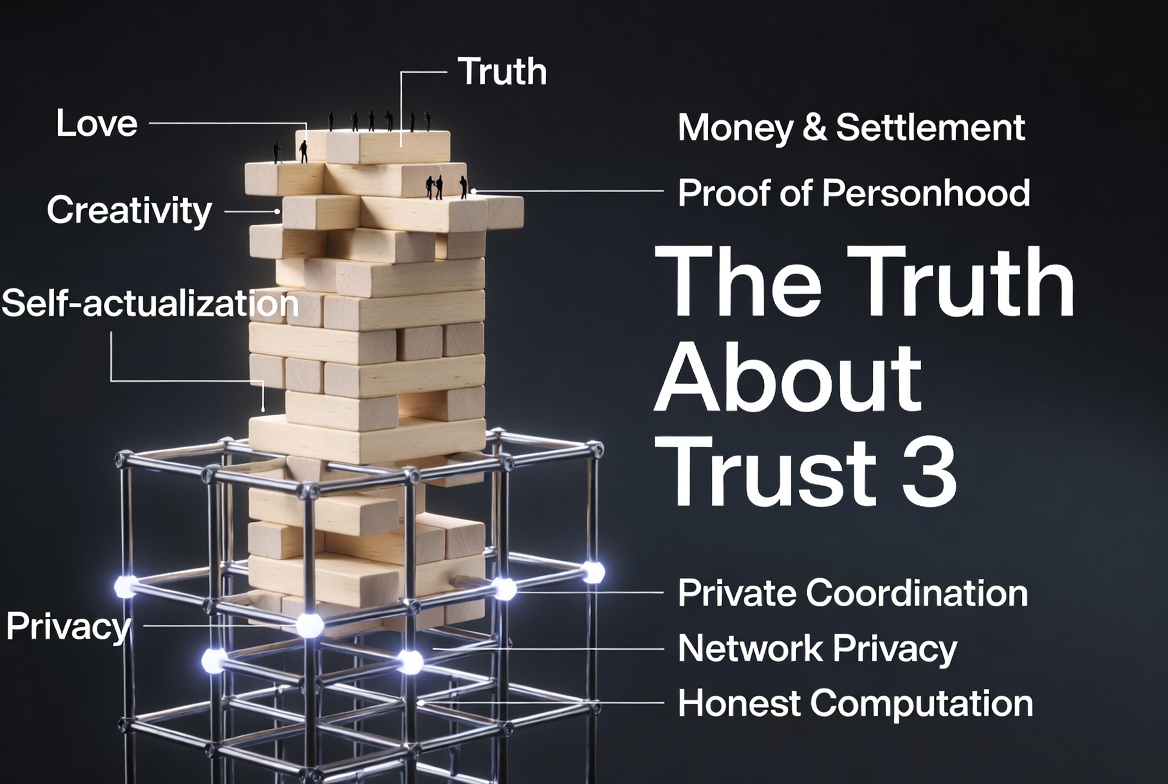
Not only the scaffolding wrapped around buildings, but the invisible kind wrapped around life itself. The records, rules, rituals, institutions, and tools that let strangers cooperate without collapsing into panic or predation. Most of the time, that scaffolding hides in plain sight. Payments clear. Doors open. Credentials hold. Packages arrive. Messages land. A person remains identifiable enough to work with, but not so exposed that they become easy prey. The structure fades into the background precisely when it is doing its job well. That was always the deeper point hiding inside the first essay: trust is not a decorative virtue sitting politely on the shelf beside other virtues. Trust is load-bearing. Remove it and the rest of the structure starts behaving like a trap.
The second essay narrowed the field. It asked what happens when identity, data, and economic life depend on systems that can mark, track, and sort human beings without any real way to refuse. The answer was not subtle. Trust in such a setting stops describing free cooperation and begins describing managed obedience. The problem was not that technology entered the scene. The problem was where trust got placed, how much of it was demanded, and whether the person inside the system retained any genuine right to withdraw. That essay ended by naming the next task plainly: if the blade can cut both ways, then the serious work is to build the other edge of it, the scaffolding that protects trust instead of harvesting it.
That is this essay.
Not a catalog of shiny products.
Not a shopping guide for protocols.
Not another sermon about a “trustless future,” as if the human condition could be debugged away by enough cryptography.
Something more serious.
A map of the architecture we actually want.
James Madison, trying to explain why constitutional structure matters, wrote that “if men were angels” government would not need the devices built to restrain power. He was right in a way that reaches beyond constitutions. Human beings are not angels. Institutions are not angels. Markets are not angels. Protocol designers are not angels. That does not make them demons. It simply means that architecture matters precisely because virtue does not scale on command. Good systems do not assume perfect actors. They narrow the blast radius when actors fail.
That is what scaffolding means here.
Not replacing ethics.
Not replacing character.
Not replacing wisdom.
Only hardening the weak joints where abuse becomes easy, silent, and catastrophic.
The great confusion of the last decade came from people imagining two false choices. On one side stood the old world of blind trust: trust the bank, trust the platform, trust the registrar, trust the state, trust the administrator, trust the interface, trust the process. On the other side stood a fantasy world where trust disappears altogether and mathematics solves politics, culture, and human weakness in one clean stroke. Both pictures were childish.
Trust never disappears. It moves.
A ledger can reduce how much we trust a central bookkeeper, but then we trust a protocol, a validator set, and the integrity of the cryptography. A credential system can reduce how much we trust a particular clerk, but then we trust whoever defines the schema and whoever controls the root keys. A private payment system can reduce how much we trust intermediaries with our transaction history, but then we trust the design of the pool, the soundness of the proofs, and the boundaries of the anonymity set. The real question was never whether trust can be removed. The real question is whether trust can be placed in healthier locations, in smaller amounts, under terms that remain visible, limited, and revocable.
That last word matters more than most people admit.
Revocable.
Article 2 argued that a trust-worthy architecture needs at least three features: revocable keys, optional participation, and limited visibility. That remains the cleanest minimum. If a person cannot rotate their keys, their life starts to congeal around static points of control. If participation in one identity rail becomes mandatory for basic existence, trust degrades into dependency. If every actor in the chain can correlate every part of a person’s life, privacy disappears and freedom follows it out the door. None of those are luxuries. They are baseline conditions for trust that remains chosen rather than imposed.
The first beam in that scaffolding is money.
Money looks abstract because modern life trained people to treat numbers on screens as reality itself. Yet the older insight from the first essay still holds: money is not value. Money is a symbol that condenses trust. It works because people believe the symbol can be exchanged tomorrow for food, energy, labor, time, or shelter. Trouble begins when symbols float so far from real production and real obligation that the scoreboard starts impersonating the game. At that point the system can still look rich while becoming brittle. The task for the next generation of monetary rails is not to worship code for its own sake. It is to reconnect settlement, accounting, and ownership to systems people can inspect and to assets that refer back to the world beyond pure financial theater. Article 4 can go deep here. For now the broad point is enough: a healthier trust architecture does not abolish money; it disciplines the places where claims get recorded, transferred, and verified.
The second beam is proof of personhood without bodily surrender.
A decent society has a real problem to solve here. People do need ways to show they are eligible, qualified, adult, resident, unique, authorized, or simply human. The mistake was never the desire to prove something. The mistake was forcing the person to hand over their whole dossier, or worse, their unchangeable body, in order to prove one narrow fact.
That is why the most interesting work now is not trying to build one giant master identity. It is trying to narrow proof itself. ZKPassport is explicit about this: it lets developers request and verify specific identity attributes from passports or other documents without exposing unnecessary personal information. Reclaim takes a parallel approach from another direction, proving that shared data came directly from the intended website and remained unaltered, so a person can verify a fact from the source without dumping raw account access into someone else’s database. Rarimo pushes further toward a pluralistic identity layer, describing a permissionless zk registry meant to preserve history and identity attributes without forcing everyone into a single issuer-owned mold. Different approaches, same civilizational instinct: prove less, reveal less, surrender less.
That is an instinct you can trust because bodies do not rotate.
Passwords can rotate.
Keys can rotate.
Devices can rotate.
A face does not rotate.
An iris does not rotate.
A hand does not rotate.
Once a system ties ordinary life to features of the body that cannot be changed, every scanner becomes a potential checkpoint and every compromise becomes permanent. That is why “proof of personhood without orbs” is not a slogan but a design demand. Any system worthy of trust must preserve a meaningful difference between proving a claim and surrendering the whole claimant. Article 5 will handle that territory in detail. Here it is enough to say that the architecture of freedom depends on keeping identity granular, user-held, and revocable wherever revocability is possible.
The third beam is privacy, and privacy has been badly misunderstood.
People still talk about privacy as if it were a cosmetic preference, something for dissidents, adulterers, criminals, or the self-consciously paranoid. That view is beneath serious thought. Privacy is what keeps every human exchange from becoming performance. Without privacy, every friendship becomes self-conscious, every experiment becomes dangerous, every transaction becomes a statement, and every deviation becomes legible to systems that may or may not deserve to see it.
Edward Snowden once said that dismissing privacy because one has “nothing to hide” is like dismissing free speech because one has “nothing to say.” The line landed because it cut through a whole swamp of lazy argument in one stroke. Privacy is not mainly about secrecy. Privacy is about the integrity of the person. It is about having rooms in life where one is not constantly translated into data for someone else’s use.
This is where web3 privacy work becomes concrete.
Aztec describes itself as a privacy-first Layer 2 for Ethereum, built so developers can choose what remains public and what remains private, with private state and private smart contracts as first-class design goals. RAILGUN approaches the same terrain from another angle: privacy built directly on the underlying chains, so users can interact privately with DeFi and smart contracts without leaving the security of their preferred chain. zkBob narrows the scope toward everyday private transfers, especially stablecoin-denominated ones, aiming for cash-like discretion in ordinary payments. Umbra shows the importance of stealth receiving, a quiet but profound point: even receiving value should not require publishing a permanent beacon for the entire world to follow forever. Privacy Pools pushes into selective disclosure, trying to create anonymous transfers without forcing every user to share an anonymity set with every possible illicit flow. These tools do not all agree. They do not all make the same tradeoffs. That is healthy. A mature privacy ecosystem should contain several distinct answers to the same human need.
That diversity matters for another reason too: privacy is not one thing.
Sometimes the problem is protecting balances and counterparties.
Sometimes it is hiding intent before execution.
Sometimes it is receiving money without exposing a permanent identifier.
Sometimes it is proving innocence without exposing the full path of funds.
Sometimes it is voting without making bribery easy.
Sometimes it is simply keeping one domain of life from being correlated with every other domain.
A weak culture keeps asking for one master solution. A stronger culture understands that different trust failures occur at different layers and need different defenses.
That brings us to the fourth beam: private coordination.
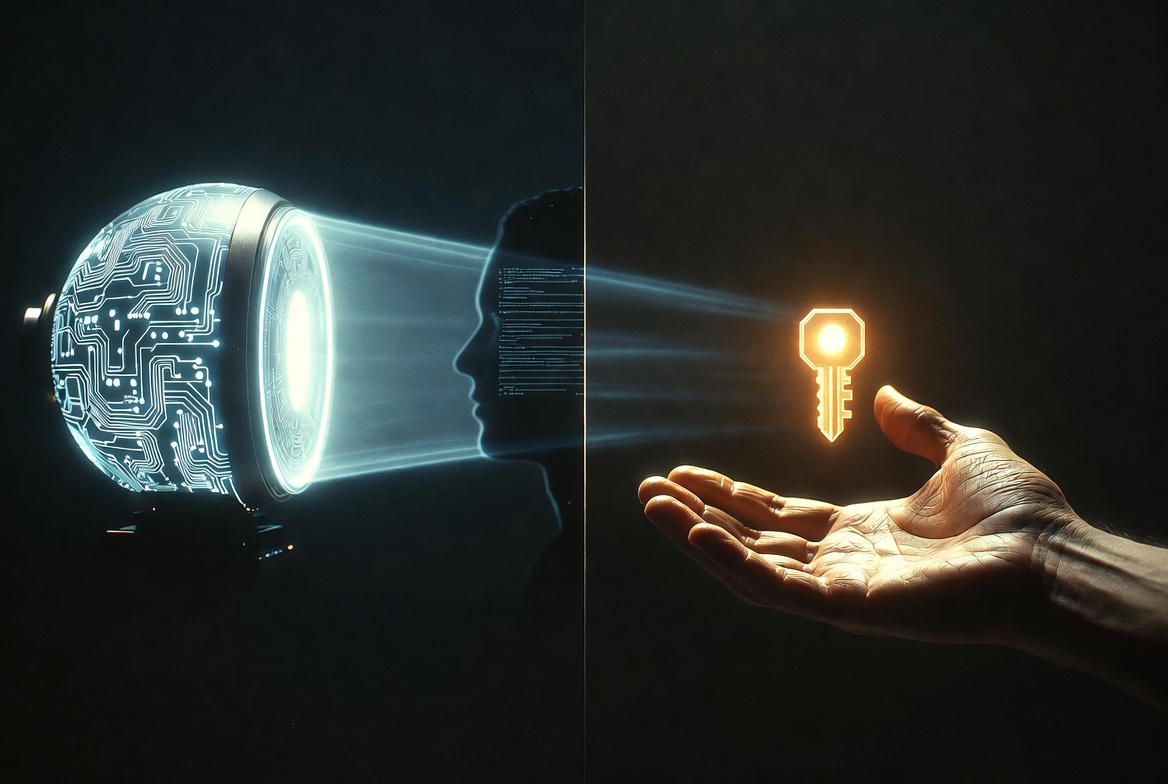
Most people understand why a ballot should be secret. Fewer understand why the same logic applies to many digital forms of governance. Public voting sounds noble until one remembers bribery, retaliation, coercion, and the quiet social pressure that makes people perform loyalty rather than express judgment. MACI exists precisely because today’s public onchain voting makes bribery too easy: if a voter can prove how they voted, a briber can reward them for it. MACI’s answer is private, collusion-resistant onchain voting, where results remain verifiable while specific votes become difficult to weaponize. Shutter attacks a nearby problem from another direction through threshold encryption, aiming for fairness and information symmetry in blockchain systems, with applications ranging from malicious MEV prevention to shielded voting. The common thread is simple: not every public system should force every internal choice to be public in real time. Sometimes the integrity of the process depends on preserving opacity at the right moment and revealing only what the process truly needs to reveal.
The fifth beam sits lower than many people realize: network privacy.
Even perfect onchain privacy can fail at the seams. If a person’s wallet activity can be linked to their IP address, their RPC requests, their timing patterns, or the metadata of the traffic around them, then the beautifully encrypted application layer starts behaving like a glass house with a steel lock on the front door. The lock may be real. The walls are still transparent.
Nym was built around that neglected fact. Its mixnet is designed to protect metadata, not only content, and its own materials keep stressing that metadata can deanonymize crypto activity even when the chain itself only shows pseudonyms. HOPR makes a similar argument: metadata privacy needs a mixnet, and blockchain interactions themselves need protection from data-harvesting gateways and RPC providers. This category may look more technical and less glamorous than identity wallets or private DeFi. In truth it is just as foundational. Without network privacy, many “private” systems remain private only for people not being seriously watched.
The sixth beam is honest computation.
Public chains gave the world one enormous gift: shared state that many parties can verify. They also exposed one enormous limitation: if every input, every balance, every condition, and every internal branch must remain public, then large classes of real-world coordination become awkward at best and impossible at worst. Business logic, medical logic, salary logic, procurement logic, institutional logic, even ordinary bargaining often require confidentiality at the input layer while still demanding trust at the output layer.
That is why so much energy has moved toward private-by-default computation. Miden emphasizes client-side proofs, local data, and private execution rather than pure pseudonymity. INTMAX describes a stateless, client-driven architecture optimized for privacy and scalability, especially for payment use cases. TEN is pursuing privacy through encrypted Layer 2 design and trusted execution environments. Fhenix and Zama are pushing another frontier: confidential compute on encrypted data, using fully homomorphic encryption to let contracts compute without forcing the underlying inputs into the open. Different cryptographic traditions, different trust assumptions, different performance envelopes, but all circling the same civilizational problem: how do you let people verify that a computation was honest without forcing them to publish every meaningful thing about themselves along the way?
This is where one of Hannah Arendt’s warnings still bites. Bureaucracies, at their worst, turn human beings into “mere cogs.” That phrase stays alive because it captures the deepest danger in badly designed systems: the reduction of living persons into legible components of a machine whose goals they did not meaningfully choose. A humane computational order would not demand perfect visibility in exchange for inclusion. It would not ask people to become fully machine-readable before they can be trusted. It would aim instead for a narrower discipline: reveal enough to verify the relevant act, but not enough to dissolve the person into a file.
The seventh beam is AI, which is really a pressure multiplier across all the others.
AI did not invent the trust crisis. It accelerated it. Once language, images, voice, code, and eventually agency can be generated or mediated by systems that do not themselves bear human consequences, every unresolved question about identity, provenance, privacy, and coordination gets louder. Who said this? Which model acted? On whose authority? Under what constraints? With what audit trail? Can the agent spend? Can it vote? Can it sign? Can it lie persuasively enough that nobody notices until the damage is done?
Article 9 will do the deep work there. For now one broad point is enough. AI makes the scaffolding question more urgent, not less. If software is going to act economically, then identity, permissioning, reputation, logging, revocation, and constraint systems all have to become more serious. Otherwise people will find themselves living inside systems where decisions are made at machine speed while accountability still moves at the speed of public confusion. The answer is not to panic. The answer is to insist that agentic systems inherit the same demands we are already learning to place on human institutions: limited authority, verifiable action, auditable provenance, and meaningful exit.
By now the pattern should be visible.
The scaffolding we actually want is not one protocol.
It is not one chain.
It is not one wallet.
It is not one identity card, one proof system, one privacy tool, or one perfect market design.
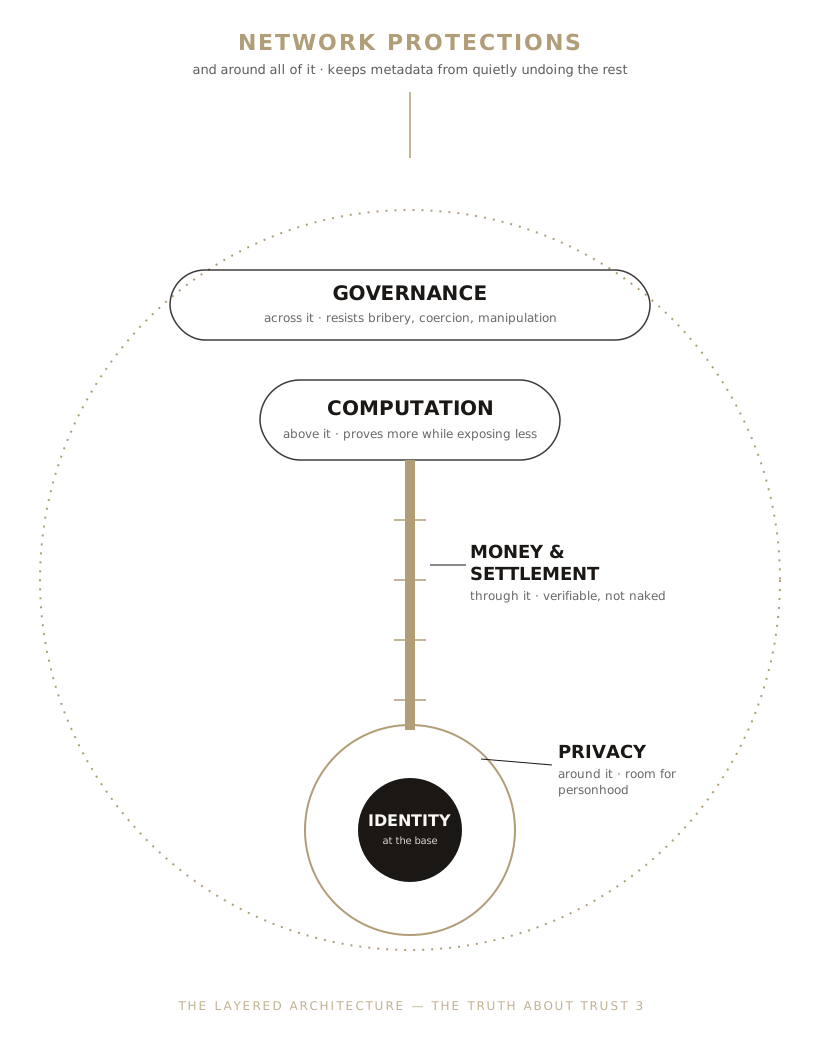
It is a layered architecture with a recognizable moral shape.
At the base: identity that does not belong to an overlord.
Around it: privacy that preserves room for personhood.
Through it: money and settlement rails that are visible enough to verify but not so naked that every life becomes a ledger entry.
Above it: computation that proves more while exposing less.
Across it: governance that resists bribery, coercion, and silent manipulation.
And around all of it: network protections that keep metadata from quietly undoing the rest.
None of those layers abolishes trust.
They civilize it.
They shrink the places where trust must be blind.
They enlarge the places where trust can be checked.
They preserve the conditions under which trust can remain freely given.
That last phrase matters because it brings us back to the start.
The goal was never to build a world where nobody relies on anyone. That world would not be freedom. It would be isolation fortified by paranoia. The goal is to build a world where people can rely on one another without having to surrender themselves wholesale to systems that remember too much, reveal too much, and forgive too little.
In other words: a world where trust is still human, but the machinery around it has become harder to abuse.
That is the work.
Not glamorous enough for slogans.
Not simple enough for marketing decks.
Not neat enough for ideologues who want one camp to conquer the other.
Just the patient labor of building better joints in the tower before the next strong wind arrives.
The first essay argued that trust is the only real value layer. The second showed what happens when identity systems remove the right to refuse. This third essay draws the map that follows from both: if trust is load-bearing, then the civilization worth building is the one that protects the conditions of trust rather than extracting it as raw material. Technology will not make people kind. It will not make institutions wise. It will not save us from the moral burden of choosing whom and what to trust. At best it can do something both humbler and more important.
It can help us build a world where fewer betrayals become permanent.
It can help us build rooms without microphones, credentials without dossiers, money without compulsory confession, computation without total exposure, and governance without easy coercion.
It can help us keep the blade facing the right direction.
And if we do that well, the word “trustless” can finally shrink back to its proper size. The deeper trust will remain what it always was: the courage to rely on one another, backed by the right to walk away when we must.